
API PH TEST KIT 250-Test
4.6Editor score
250 tests per bottle
Accurate 6.0 to 7.6 range
Includes color card and tube
This guide compares the top 10 aquarium pH testers for accuracy, ease of use, and value. Find the best water quality monitor for your fish tank needs.
Maintaining proper water chemistry is essential for healthy fish. pH testers help hobbyists monitor acidity levels to ensure a safe environment. Choosing the right tool prevents stress and disease in your aquatic pets effectively.
We evaluated ten popular testers based on accuracy, durability, and user feedback. Our analysis covers digital pens, liquid kits, and continuous monitors. Each option suits different budgets and maintenance preferences for aquarium keepers.
Every pick highlights key strengths and potential limitations for your tank setup. Prices may fluctuate so check current listings before purchasing. Use this guide to select the most reliable testing solution for your specific needs.
4.6Editor score

4.4Editor score

4.2Editor score
This table provides a side-by-side comparison of all ten selected aquarium pH testers. It highlights key specifications to help you identify the best fit for your specific monitoring requirements and budget constraints.



The AAwipes 8-in-1 Aquarium Test Kit stands out as a versatile solution for monitoring water quality. It holds a 4.3 rating and offers comprehensive testing across eight different parameters in a single strip.
We may earn a commission when you buy through this link, at no additional cost to you.
This kit measures Free Chlorine, Nitrate, Nitrite, Hardness, Sodium Chloride, Total Alkalinity, pH, and Ammonia nitrogen. The process involves dipping the strip and comparing colors to a chart for up to 99 percent accuracy. It is suitable for both freshwater and saltwater environments.
One trade-off is the specific timing required for different pads. The Ammonia nitrogen pad needs a longer wait time than the others. However, this detail ensures more precise readings for critical parameters.
Aquarium owners seeking a broad overview of water chemistry will find this kit invaluable. It helps prevent hidden water problems and ensures the safety of fish without lab fees.
Testing eight parameters at once saves time and provides a holistic view of tank health.
The kit works for aquariums, ponds, and pools, making it a flexible tool for various water setups.
We may earn a commission when you buy through this link, at no additional cost to you.
The VIVOSUN Digital pH Meter TDS EC Meter offers a digital approach to water testing with a rating of 4.1. It covers the full pH range from 0 to 14 reliably. This device is designed for home and laboratory testing applications including aquariums.
We may earn a commission when you buy through this link, at no additional cost to you.
It functions as a 3-in-1 meter, measuring pH, TDS, and conductivity. The unit comes with a protective case and three calibration buffers for setup. The handheld design makes it portable for use in different locations easily.
A notable limitation is that the meter cannot test sea water effectively. Also, accuracy is listed as plus or minus 2 percent. These factors should be considered for saltwater tanks requiring high precision.
Freshwater aquarium owners and hydroponics users will appreciate the multifunctionality. It provides quick readings and essential calibration tools in one package for convenient monitoring.
Beyond pH, it tracks TDS and conductivity for a deeper understanding of water quality.
The lightweight design and protective case ensure the device remains safe and ready for use.
We may earn a commission when you buy through this link, at no additional cost to you.
The API PH TEST KIT 250-Test is a top contender with a 4.6 rating. It offers 250 tests per bottle and accurately reads pH from 6.0 to 7.6. This kit includes a testing solution bottle, color card, and test tube.
We may earn a commission when you buy through this link, at no additional cost to you.
It helps monitor and adjust pH to prevent invisible water problems harmful to fish. The kit is designed for weekly monitoring and detecting fluctuations caused by waste or food. It addresses different tap water conditions effectively.
The main constraint is the limited pH range which suits most freshwater tanks but not all marine setups. Liquid kits also require more steps than strips. However, the cost per test is very low.
For freshwater aquarists prioritizing value and reliability, this kit is an excellent choice. It helps maintain optimal pH levels to ensure fish health and prevent loss.
With 250 tests, this bottle lasts significantly longer than many competitors.
The brand is trusted by hobbyists for accurate readings that help avoid fish loss.
We may earn a commission when you buy through this link, at no additional cost to you.
The API High Range pH Test Kit holds a 4.6 rating and specializes in higher pH levels. It accurately reads from 7.4 to 8.8, which is ideal for Goldfish, Marine, and African Cichlids. It includes a testing solution bottle and test tube.
We may earn a commission when you buy through this link, at no additional cost to you.
This kit monitors and adjusts pH to prevent invisible water problems harmful to fish. It detects fluctuations caused by waste and food. It is suitable for both freshwater and saltwater aquarium environments effectively.
Users with low pH requirements like soft water African Rift Lake fish may find this range insufficient. Liquid kits also involve more handling than strips. Yet, the specific range is unmatched in this price tier.
Aquarists keeping high pH species should choose this kit for accurate monitoring. It ensures water parameters stay within safe limits for specific biological needs.
The 7.4 to 8.8 range covers specific needs for marine and cichlid keepers.
This kit works in both freshwater and saltwater setups, increasing its versatility.
We may earn a commission when you buy through this link, at no additional cost to you.
The Digital pH Meter Tester Pen offers a 3.9 rating and high accuracy of ±0.01. It covers the full 0 to 14 pH range and is pre-calibrated for immediate use. The device is pocket-sized for easy carrying anywhere.
We may earn a commission when you buy through this link, at no additional cost to you.
Operation is simple: turn it on, immerse the probe, and stir until the reading stabilizes. It is ideal for drinking water, pools, and aquariums. Calibration is possible via standard powders if needed.
However, calibration steps might confuse new users and readings can vary with water conditions. The 3.9 rating suggests potential quality control issues. Still, the pre-calibrated feature adds convenience.
Those needing a portable, high-accuracy pen for general water testing should consider this option. It allows quick checks without needing extensive setup.
A 0.01 accuracy rating helps detect small changes that might stress sensitive fish.
Pre-calibration allows users to start testing right out of the box.
We may earn a commission when you buy through this link, at no additional cost to you.
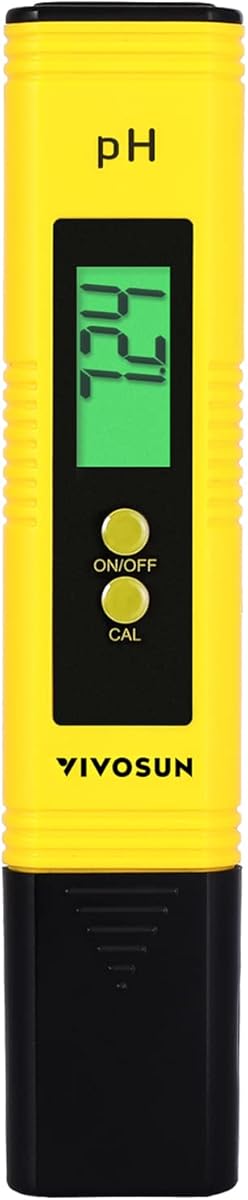
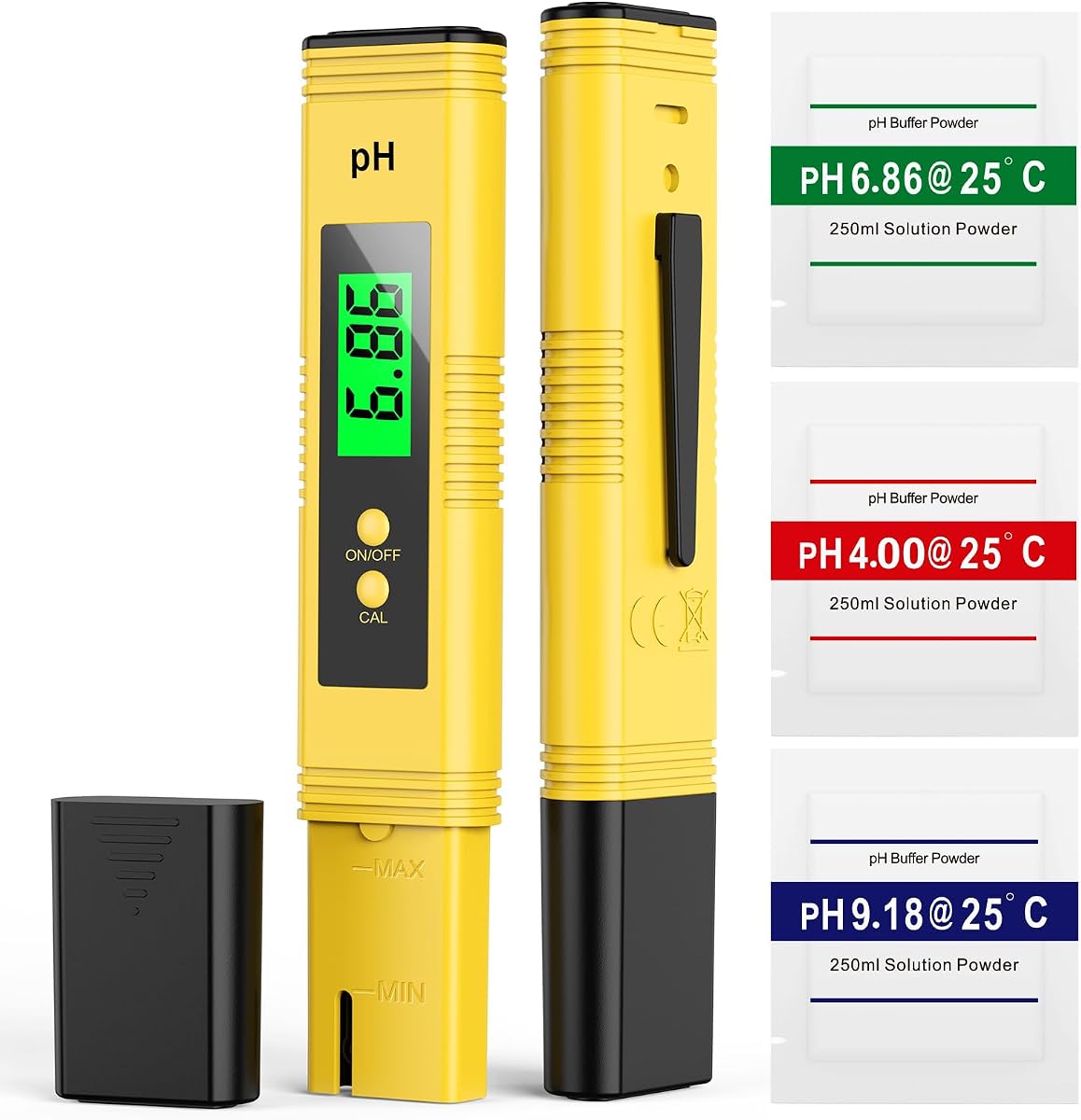
The VIVOSUN Digital pH Meter holds a 3.8 rating and is ideal for residential and commercial use. It features 0.01 accuracy with an LCD screen for clear reading. It comes with 2 button cells and 3 pH buffer powders included.
We may earn a commission when you buy through this link, at no additional cost to you.
Advanced technology makes test results fast and accurate. The backlit function aids visibility in low light. Automatic Temperature Compensation adjusts readings based on water temperature instantly.
Despite these features, the 3.8 rating indicates mixed user satisfaction. Calibration is necessary and users must manage it carefully. Battery life may be shorter if not monitored closely.
For those seeking an affordable pen with basic ATC features, this option works. It provides essential tools for monitoring water quality in hydroponics and aquariums.
ATC ensures readings remain accurate regardless of water temperature changes.
The backlit LCD screen makes it easy to read values in dim environments.
We may earn a commission when you buy through this link, at no additional cost to you.
The Digital PH Meter with ATC has a 3.9 rating and offers a full 0 to 14 measurement range. It includes Automatic Temperature Compensation to adjust for liquid temperature automatically. The mini size allows easy pocket carry for testing anywhere.
We may earn a commission when you buy through this link, at no additional cost to you.
It is ready for use out of the box. Calibration involves placing the tester in calibration solutions. The device reads values once they stabilize after stirring to ensure contact.
Calibration requires careful selection of powder standards. Users may find stabilization times variable depending on water conditions. Despite this, the ATC feature is a strong convenience point.
Aquarists needing portable testing with temperature correction will find this suitable. It simplifies the process of getting reliable readings without manual adjustments.
Automatic Temperature Compensation eliminates errors caused by fluctuating water temperatures.
The mini size ensures you can carry the device to pools or camping trips easily.
We may earn a commission when you buy through this link, at no additional cost to you.
The 2025 All-New pH Meter holds a 3.8 rating with UL certification and 0.01 precision. It is factory calibrated for ready use. The device comes with a detailed manual and 3 pH buffer powders.
We may earn a commission when you buy through this link, at no additional cost to you.
Immersing the meter in water and stirring ensures air bubbles are removed. For first use, the electrode needs 30 minutes to activate. This attention to detail aims for reliable performance.
The requirement for electrode activation may deter users seeking instant use. However, the UL certification provides confidence in safety and accuracy. This makes it a trustworthy option for many households.
Homeowners and hobbyists prioritizing certified safety should consider this meter. It balances precision with compliance to quality standards.
UL certification ensures the device meets specific safety and performance standards.
Being factory calibrated allows for immediate testing without complex setup procedures.
We may earn a commission when you buy through this link, at no additional cost to you.
The Seachem pH Alert 6 Month offers continuous monitoring with a 4.2 rating. It uses Seachem sensor technology to track pH levels without tests or strips. This device lasts up to six months, which is four times longer than competing products.
We may earn a commission when you buy through this link, at no additional cost to you.
It is designed for freshwater tanks and eliminates the need for manual testing. The sensor provides ongoing data to help maintain stability. It is ideal for hobbyists who want peace of mind without frequent testing.
The main drawback is the lack of a digital readout. Users rely on color changes rather than exact numbers. Yet, the duration and convenience are significant advantages for long-term monitoring.
Aquarists seeking a set-and-forget solution will find this tool valuable. It ensures continuous pH stability with minimal maintenance effort.
Continuous monitoring captures shifts that might happen between weekly test routines.
With a six-month lifespan, this sensor offers long-term value compared to shorter lasting options.
We may earn a commission when you buy through this link, at no additional cost to you.
The APERA INSTRUMENTS AI209 Value Series holds a 4.4 rating and is fully waterproof. It features automatic temperature compensation to ensure accuracy. The kit includes a rugged carrying case, pH buffers, and a lanyard.
We may earn a commission when you buy through this link, at no additional cost to you.
It offers auto recognition of stable values for consistency. The device runs up to 2000 hours on AAA batteries. The pH sensor is low impedance for high response rates and reliability.
The higher price reflects its professional features and durability. AAA batteries may need replacement over time. Still, the waterproof build and long operation time justify the investment for serious users.
For those needing a robust, waterproof tester, this is a premium choice. It delivers consistent performance for both lab and aquarium environments.
A waterproof build prevents accidental damage during regular water testing routines.
With up to 2000 hours of operation, this device offers substantial usage time per battery set.
We may earn a commission when you buy through this link, at no additional cost to you.
Selecting the right pH tester involves considering several key factors. This guide explains what to look for to ensure reliable monitoring.
Accuracy determines how precise your readings are. Look for testers with at least 0.01 or 0.1 accuracy for reliable results. The pH range should match your tank type, typically 0 to 14 for full coverage. Some kits only cover specific ranges like 6.0 to 7.6 for freshwater.
Prioritize accuracy that aligns with your fish needs and ensure the range fits your water type.
Different methods include liquid kits, test strips, digital pens, and continuous monitors. Liquid kits offer high accuracy but take more time. Strips are quick but less precise. Digital pens provide instant digital readouts. Continuous monitors track changes over time without manual input.
Choose a method that balances speed and precision for your routine.
Some testers require complex calibration steps or specific timing. Others are pre-calibrated for immediate use. Look for devices with clear instructions and intuitive interfaces. A backlit screen or color-coded chart can simplify reading results.
Opt for a user-friendly design to maintain consistency in testing.
Digital testers should be waterproof to survive accidental spills. Physical kits must have sealed bottles to prevent solution evaporation. Continuous sensors need to remain stable in water for long periods. Look for brands with proven reputations for quality.
Select a robust product that withstands regular tank maintenance tasks.
Features like Automatic Temperature Compensation (ATC) adjust readings for water temperature. Some digital meters measure TDS or conductivity as well. Include kits often save money over time. These features add value and convenience to your testing routine.
Consider extra capabilities that align with your monitoring goals.
Price varies widely from a few dollars to over fifty. Calculate cost per test for liquid kits and strips. Digital pens may cost more upfront but last longer. Balance budget with expected lifespan and accuracy needs.
Aim for the best value relative to testing frequency and reliability.
Some testers are specific to freshwater or saltwater. Others work for both but may require different calibration steps. Ensure the product description confirms compatibility with your specific tank type. Mismatched ranges can lead to inaccurate readings.
Verify compatibility to avoid testing errors in your aquarium setup.
Digital meters often need calibration using buffer powders. Check if the device comes with calibration solutions included. Pre-calibrated units save time but may drift over time. Understand the frequency needed to maintain accuracy.
Plan for regular calibration to keep readings trustworthy over time.
For liquid kits, clean the test tube and fill it with tank water. Add the testing solution drop by drop and shake gently. Compare the resulting color to the chart provided in the kit under natural light.
Digital testers should be rinsed with distilled water before and after use. Immerse the probe and stir gently until the reading stabilizes. Store the pen in a protective cap or solution to keep the electrode hydrated.
Continuous monitors must be attached securely to the tank glass. Replace the sensor when it expires according to the manufacturer instructions. Keep all testing devices away from direct sunlight to preserve solution integrity.
You should test your aquarium pH at least twice a week for stable water quality. During new tank setups or after adding new fish, test daily for a week. If you notice fish stress, check immediately to identify issues early.
Digital pens can offer high accuracy with 0.01 precision if properly calibrated. Liquid kits from trusted brands like API are also highly reliable for specific ranges. Consistency in calibration often matters more than the type of device.
pH levels can shift due to photosynthesis, respiration, and CO2 levels. Plants absorb CO2 during the day which raises pH. Check consistently at the same time of day to track trends accurately over time.
Most freshwater fish thrive between pH 6.5 and 7.5. However, species like African Cichlids prefer higher pH levels around 8.0. Research your specific fish to match water parameters to their natural habitat.
Calibrate using buffer solutions of pH 4.00, 7.00, or 10.01. Immerse the probe in the buffer and follow the device instructions. Rinse with distilled water between calibrations and store properly to maintain accuracy.
No, distilled water is not suitable for calibration because it has no buffering capacity. Use specific pH buffer powders or solutions designed for this purpose. Improper calibration can lead to significant measurement errors in your readings.
Slow stabilization often means the electrode is dry or dirty. Soak the probe in pH 4 buffer or distilled water for an hour before testing. Clean the probe regularly to remove oils or residue affecting performance.
Daily calibration is not necessary for hobbyists but weekly checks are wise. If you notice inconsistent readings, calibrate immediately to ensure accuracy. For professional use, daily calibration may be required to maintain precision.
We have reviewed ten top options ranging from budget kits to premium digital devices. The API 250-Test Kit offers the best value for freshwater keepers needing high test counts. Digital pens like the APERA AI209 provide reliable precision for demanding users.
When choosing, prioritize accuracy and ease of use for your specific needs. Continuous monitors like Seachem provide ongoing data without daily effort. Ensure the range matches your fish species to avoid potential health issues in the tank.
Always verify current prices and availability on Amazon before purchasing. Conditions and stock vary so double-check listings to secure the best deal. Use this guide to confidently select a tester that keeps your aquatic pets safe.