
Siraya Tech Tenacious Flex
4.7Editor score
Soft rubber-like flexibility
Excellent impact resistance
Great for shock absorption
This comprehensive guide compares the top flexible resin for 3D printing options available in October 2026 to help you choose the best material.
Finding the right flexible resin for 3D printing can transform your projects from rigid prototypes to functional parts. Whether you need shock absorption or rubber-like flexibility, selecting the correct material matters significantly for print success.
We evaluated ten leading products based on flexibility, durability, ease of use, and user feedback. Our analysis covers everything from Shore hardness levels to curing times to ensure you find a resin that meets your specific technical needs.
Each pick below highlights key strengths and ideal applications for diverse printing tasks. Please note that availability and specific formulation details may change over time, so always verify current product listings before purchasing.
4.7Editor score
4.7Editor score
4.2Editor score
This side-by-side comparison highlights the key specifications and performance characteristics of the top flexible resins available for LCD, DLP, and SLA 3D printers.



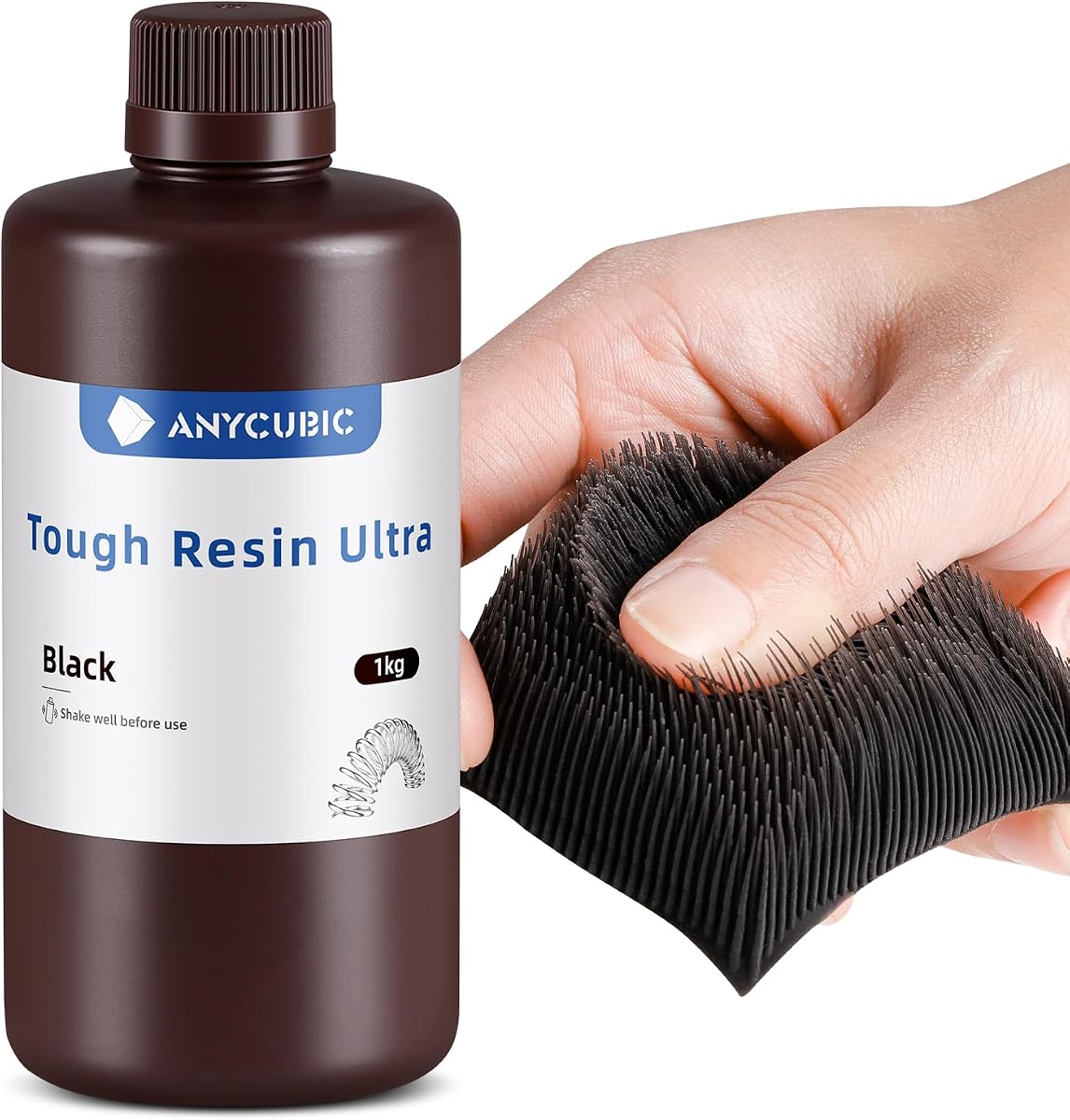
The ANYCUBIC Ultra Tough Resin stands out as a top performer in the flexible resin category for November 2026. With a high rating from users, it delivers exceptional toughness and flexibility that rivals traditional rubber materials.
We may earn a commission when you buy through this link, at no additional cost to you.
Its capacity to swiftly recover its original shape after deformation makes it perfect for parts subjected to external forces. The resin is tailored for crafting articulated models, allowing seamless movement and interchangeability of parts without breaking.
While it offers a non-irritating experience on skin upon curing, users should note that blending it with other resins might affect final colors if not managed carefully. However, the durability benefits often outweigh this minor trade-off.
This resin is highly recommended for makers who need durable, wearable, or moving parts like earphone covers or structural components that require high flexibility and robust adaptability in various environments.
The material exhibits remarkable resistance to brittleness and softening, ensuring outstanding performance even in high humidity or damp conditions.
Its gentle skin sensation makes it ideal for crafting daily wearable models like elf ears or protective cases where comfort is critical.
We may earn a commission when you buy through this link, at no additional cost to you.
Siraya Tech Tenacious Flex Black offers a softer, more rubber-like experience than its classic predecessor. It is designed for users who need faster rebound and incredible elasticity for resilient 3D prints.
We may earn a commission when you buy through this link, at no additional cost to you.
The enhanced flexibility allows it to withstand extreme bending and compression, quickly returning to its original shape. This makes it exceptionally useful for dynamic parts that require constant movement or stress tolerance.
Its high impact resistance ensures models remain protected against accidental drops or impacts without cracking. However, because it is different from the original Tenacious resin, it may not suit all applications where the classic version was typically used.
Budget-conscious makers looking for specialized applications like soft grips, gaskets, or shock-absorbing components will find this resin provides excellent value and performance in flexible printing scenarios.
Superior elasticity allows for more dynamic and flexible prints that resist permanent deformation under heavy compression.
Ideal for projects requiring high flexibility such as pliable prototypes and durable yet not brittle objects.
We may earn a commission when you buy through this link, at no additional cost to you.
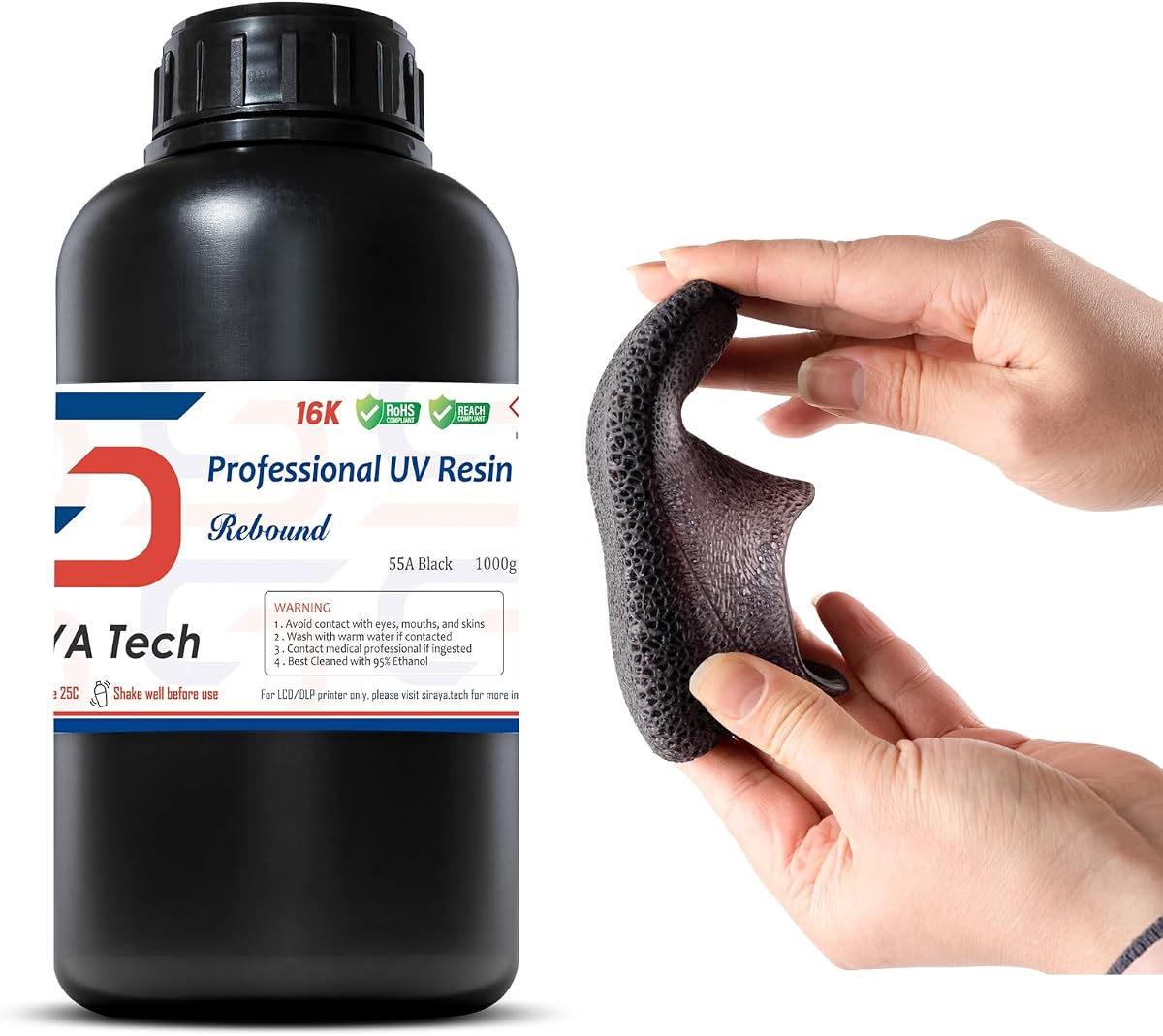
Siraya Tech Rebound 55A is designed for applications requiring quick shape recovery and impact absorption. Its fast rebound action sets it apart from standard elastic resins in terms of performance speed.
We may earn a commission when you buy through this link, at no additional cost to you.
Initial testing shows good resilience during compression cycles, maintaining elasticity over repeated use. It offers a balanced mix of flexibility and structural integrity, being softer than Tenacious Flex while maintaining excellent compression properties.
Unlike other elastomers that require complex processing, this resin prints on standard LCD and DLP 3D printers and cleans with standard isopropyl alcohol. However, long-term performance testing is still ongoing to confirm durability.
This premium option is well-suited for personal protective equipment prototypes, industrial prototyping like gaskets, and consumer products where elasticity and rebound performance are key factors for success.
Provides significantly faster rebound than standard elastic resins making it an excellent choice for impact absorption.
Prints on standard LCD and DLP 3D printers without special cleaning requirements like A/B mixing.
We may earn a commission when you buy through this link, at no additional cost to you.
Superflex 3D Printer Resin is engineered for speed, printing 50um layers in just 1.7 seconds on monochrome LCD 3D printers. This speed enhances productivity significantly for 3D printing farms.
We may earn a commission when you buy through this link, at no additional cost to you.
It offers a balanced softness and strength to simulate rubber or TPU for hard flexible prototypes. With 80A Shore hardness and 100% elongation at break, it is well-suited for cushioning and shock absorption applications.
Properly cleaned and fully post-cured prints pass the ISO 10993-5 test, making it suitable for safer applications. However, the small 500g bottle size means frequent reordering compared to 1kg options available in the market.
This resin is perfect for users prioritizing time and electricity savings without compromising on the flexibility needed for damping and shock absorption functional parts.
Enhances the productivity of 3D printing farm by at least 40 percent and up through fast layer curing.
Passes ISO 10993-5 tests when properly cleaned, ensuring safety for skin contact applications.
We may earn a commission when you buy through this link, at no additional cost to you.
ANYCUBIC Tough Resin 2.0 has undergone a comprehensive upgrade in flexural strength to make it less prone to fracture in miniature components. It exhibits formidable strength and flexibility resisting peeling and cracking effectively.
We may earn a commission when you buy through this link, at no additional cost to you.
The low-odor friendly formulation creates a calm and comfortable printing environment, reducing volatile organic compounds. This resin maintains high precision with minimal shrinkage, ensuring printed models feature a smooth surface and clear details.
Models printed with this resin are less prone to breakage even when dropped from a height, which is ideal for durable prototypes. While the grey color is standard, the robustness of the material ensures reliability in high-strength model production.
It is applicable for industrial spare parts, building models, and DIY projects where high precision and resistance to breakage are critical requirements for success.
Features a low odor and non-irritating composition making it a green and environmentally friendly choice.
Boasts excellent precision while maintaining a low shrinkage rate for clear details in printed models.
We may earn a commission when you buy through this link, at no additional cost to you.
SUNLU high toughness 3D resin offers long-lasting toughness with elongation five times higher than regular standard resin. It has excellent flexibility and bendability making models unbreakable and durable for high-stress use.
We may earn a commission when you buy through this link, at no additional cost to you.
Its low viscosity and high flowability result in shorter curing time and easier model formation. With lower shrinkage, the potential for distortion is reduced allowing you to achieve best-in-class accuracy in vivid detail.
The resin is designed to improve printing stability reducing the volume shrinkage during the curing process so models do not crack after wash and curing. Users report a lower printing odor compared to other resins in the market.
It is widely compatible with most LCD, DLP, and SLA resin 3D printers making it a versatile choice for printing high toughness models like structural parts and solid models that require durability.
Better accuracy and printing results due to low viscosity leading to shorter curing times and easier model formation.
Printed model will not prone to cracking after wash and curing greatly improving your 3D printing success rate.
We may earn a commission when you buy through this link, at no additional cost to you.
ELEGOO Tough Resin has excellent flexibility and extraordinary resilience allowing it to be easy to bend but not easy to break. The cured resin has a Shore hardness of 84.7D exceeding that of many others for robust applications.
We may earn a commission when you buy through this link, at no additional cost to you.
It has high-strength physical properties and can withstand certain impacts making it suitable for printing structural parts, tools, and other high-performance models. The finished resin can be drilled without cracks ensuring durability in functional parts.
The material shows excellent resistance to brittleness, softening, and corrosion even in high humidity or humid environments. This reliability combined with low odor makes it a comfortable choice for producing high-quality prints.
It can be used to print end-use products, functional prototypes, jigs and fixtures, and artistic projects where durability and strong impact resistance are required for long-term utility.
Shows excellent resistance to brittleness and softening even in high humidity environments ensuring long-term reliability.
Can be used to print jigs, fixtures, and tool elements that need to stay strong under stress.
We may earn a commission when you buy through this link, at no additional cost to you.
SUNLU Flexible 3D Printer Resin offers a perfect balance of softness and strength simulating rubber or durable flexible prototypes. It has 70A Shore hardness and 135% elongation at break which exhibits formidable strength and flexibility.
We may earn a commission when you buy through this link, at no additional cost to you.
The resin offers excellent impact resistance and flexibility making printed models durable and able to withstand drops without breaking. After cleaning, you get a dry, non-sticky surface with a pleasant touch and high-resolution finish.
It has minimal odor and is made of safe materials ensuring a non-pungent printing environment. While it has a lower rating than some competitors it provides good stability and tolerance to weak acids and greases.
It is compatible with 99% of printers on the market including LCD, DLP, and SLA which makes it a versatile choice for users seeking soft, flexible items in their printing projects.
Offers a high-resolution, smooth surface finish that is dry and non-sticky after cleaning.
Features a leak-proof bottle design to reduce damage during transportation and ensure safe delivery.
We may earn a commission when you buy through this link, at no additional cost to you.
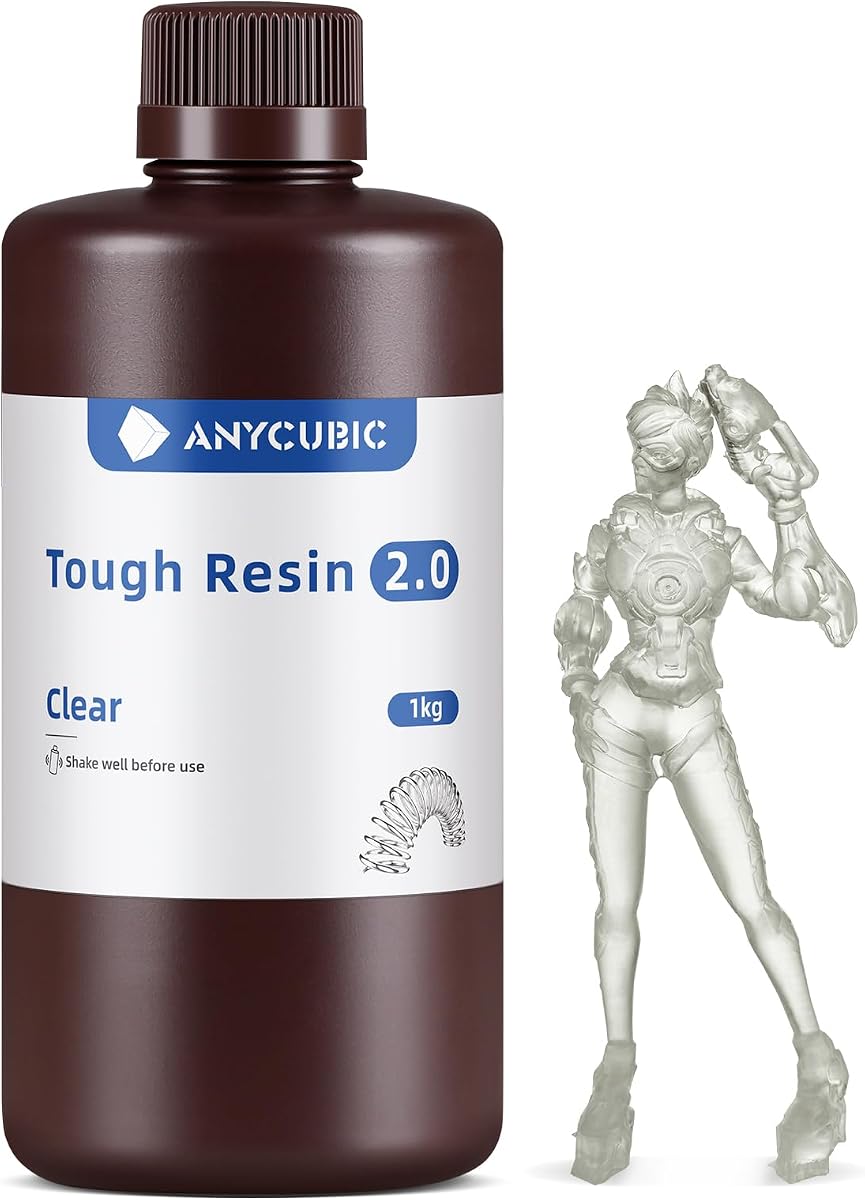
ANYCUBIC Tough Resin 2.0 in Clear offers unmatched strength and resistance to breakage. It achieves a significant enhancement in flexural strength making it less likely to break when printing delicate components.
We may earn a commission when you buy through this link, at no additional cost to you.
The resin offers exceptional strength and flexibility resisting damage caused by cyclic vibrations. Printed models are less likely to break even when subjected to drops from a height ensuring reliability in functional prototypes.
With minimal shrinkage and low-odor formulation it ensures high precision prints with a pleasant printing environment. It is highly compatible with different equipment and materials offering versatile industrial applications for makers.
This clear version is perfect for users who need to see internal structures or light transmission while still benefiting from the durability and high precision of the Tough Resin 2.0 formula.
Achieved a significant enhancement in flexural strength significantly reducing the likelihood of breakage.
Offers versatile industrial applications and is highly compatible with different equipment and materials.
We may earn a commission when you buy through this link, at no additional cost to you.
This resin simulates the toughness of rubber with 90A Shore hardness offering both softness and strength. The printed product can be folded and bent repeatedly without breaking with strong tear resistance and good bending resistance.
We may earn a commission when you buy through this link, at no additional cost to you.
It delivers high elongation and excellent tear resistance making it the go-to choice for gaskets, protective cases, and ergonomic grips. These parts need to stay flexible under repeated stress while remaining tough enough not to rip or wear out.
Say goodbye to cracked prints and broken models as this specialized formula keeps its cool under stress bending where ordinary resins snap. It does not sacrifice detail for flexibility, delivering crisp accurate prints with low odor.
It works great on most LCD and DLP printers and is ready to flex whether you are prototyping or producing end-use parts for cosplay or engineering applications.
Delivers high elongation and excellent tear resistance for real-world use in gaskets and protective cases.
Specialized formula keeps its cool under stress bending where ordinary resins snap for reliable performance.
We may earn a commission when you buy through this link, at no additional cost to you.
Selecting the right flexible resin requires considering factors like Shore hardness, elongation, and intended use to ensure the material meets your specific project requirements.
Shore hardness indicates the stiffness of the material, with lower numbers (like 55A) being softer and higher numbers (like 80A) being firmer. Choose based on whether you need a rubber-like softness or a hard flexible prototype.
Match the hardness to your application; use lower A values for soft grips and higher A values for rigid shock absorbers.
Elongation at break measures how much the material can stretch before breaking. High elongation ensures your parts can withstand deformation without snapping or failing under stress.
Prioritize high elongation if your parts will be subjected to significant bending or stretching during daily use.
Curing speed affects your overall printing efficiency. Faster curing resins reduce layer times and improve productivity for 3D printing farms or large batches.
Select a resin that balances speed with quality to avoid curing issues like under-curing or over-curing.
Impact resistance is critical for parts that might be dropped or hit. Look for resins that offer high toughness to prevent cracks and structural failure.
High impact resistance is essential for functional parts like tool handles or protective cases.
Ensure the resin is compatible with your printer's wavelength (usually 405nm for UV) and technology (LCD, DLP, or SLA). Incompatible resins may not cure properly or damage your printer.
Check the product description to confirm compatibility with your specific 3D printer model before purchasing.
Resin safety includes low odor and non-irritating formulations which are safer for skin contact and indoor printing. Look for ISO certifications if medical or wearable use is intended.
Choose low-odor resins for comfortable printing in home or office environments.
Flexible resins often require careful washing and curing to achieve desired properties. Some may stick to the printer screen or require specific alcohol concentrations for cleaning.
Plan for adequate cleaning and curing time to ensure your final parts are fully durable and safe.
Consider the cost per kilogram and bottle size. Larger bottles are often more economical but may expire if not used quickly.
Select a bottle size that fits your consumption rate to balance cost with material freshness.
Always wear gloves and a mask when handling uncured flexible resin to protect your skin from irritation. Work in a well-ventilated area to avoid inhaling fumes from the photopolymer material.
Shake the bottle gently before pouring to ensure the resin is well-mixed. Pour slowly into the resin tank to avoid bubbles that can cause layer defects during printing.
After printing, wash your parts with isopropyl alcohol thoroughly to remove uncured resin. Use UV light to post-cure the parts completely for maximum durability and flexibility.
No, you should always wear nitrile gloves when handling uncured resin. Flexible resin can cause skin irritation or sensitization if it comes into direct contact with your skin for prolonged periods.
Yes, most flexible resins are compatible with standard SLA, DLP, and LCD printers that use 405nm UV light. Check the manufacturer's specs to confirm your printer is on the supported list.
Clean flexible resin prints with 99% isopropyl alcohol. Soak gently and use a soft brush to remove uncured resin from surfaces. Avoid harsh scrubbing that might deform the soft material.
70A is softer and more rubber-like, while 80A is firmer and more rigid. Choose 70A for soft touch parts and 80A for shock absorbing components that need more structural support.
Curing times vary by brand and printer, but typically 30 to 60 minutes of UV exposure is needed for flexible resins. Follow the product guidelines to ensure the parts are fully hardened.
Yes, you can mix flexible resin with standard resin to create custom toughness levels. However, blending may affect the final color and print speed, so test small batches first.
The top picks highlighted above offer a range of flexibility from soft 55A to rigid 80A options. ANYCUBIC Ultra Tough Resin stands out as the editor's choice for its superior balance of durability and flexibility.
Prioritize factors like impact resistance, elongation, and safety when selecting your resin. Choose the material that best fits your project's specific functional requirements rather than just the lowest price.
Remember that prices and availability change frequently so always check current listings before making a final purchase. We hope this guide helps you find the perfect flexible resin for your 3D printing projects.