
Primefit CR1401G
4.5Editor score
Steel protected gauge
1 to 150 PSI range
60 SCFM flow rate
This guide compares ten top-rated air pressure regulators for compressors to help you find the right fit for your shop, tools, and painting needs.
Finding the right air pressure regulator is essential for any workshop that relies on pneumatic tools. A good regulator ensures consistent pressure, protects your equipment, and improves the quality of your work by delivering steady airflow to your tools.
We have evaluated ten highly-rated models based on build quality, flow rate, adjustment precision, and user feedback. Our comparison covers various sizes and configurations to help you choose the best option for your specific compressor setup and application needs.
Each pick highlights key features, pros, and cons to give you a clear picture of what to expect. Please note that availability and pricing can change frequently, so verify the latest details before making your final purchase decision online.
4.5Editor score

4.5Editor score

4.3Editor score
The following table provides a side-by-side look at the key specifications and features of each model to help you quickly identify the best fit for your needs.


The PneumaticPlus SAR200-N02BG stands out as a top choice for general workshop needs. It holds a strong rating and is designed to stabilize compressed air line pressure for various tools and machinery.
We may earn a commission when you buy through this link, at no additional cost to you.
Its relieving design automatically vents excess downstream pressure, protecting your tools from sudden spikes. The included gauge and bracket make installation straightforward, while the push-to-lock knob keeps settings secure.
While it offers excellent precision, you may need to recalibrate it occasionally if the shop environment is very dusty. The standard knob is functional but could be more robust for heavy industrial use.
This regulator is ideal for professionals who need reliable pressure control for paint sprayers and pneumatic machinery. Its adherence to ISO standards and responsive support make it a confident choice.
The relieving design ensures that delicate equipment like spray guns receive steady pressure without fluctuations that could ruin a finish.
Ships with all necessary mounting hardware and a gauge, so you can integrate it into your air line immediately without extra purchases.
We may earn a commission when you buy through this link, at no additional cost to you.
The Primefit CR1401G offers excellent value for those seeking reliable regulation without breaking the bank. It maintains consistent air pressure and is rated highly by users for its performance in standard shop environments.
We may earn a commission when you buy through this link, at no additional cost to you.
Its steel-protected gauge and composite knob provide durability against typical workshop wear. The high flow rate ensures that tools get enough air volume even under moderate demand conditions.
You must ensure the directional flow is set correctly during installation for it to function properly. Over time, the gauge might fog slightly, though it remains readable for general adjustments.
This is a smart pick for hobbyists or small shops that need a dependable replacement regulator. Its balance of cost and performance makes it a frequent recommendation for budget-conscious buyers.
Despite its lower cost, it delivers accurate regulation and a durable build that matches more expensive models in many scenarios.
The steel protection around the gauge adds an extra layer of safety against accidental bumps in a busy workspace.
We may earn a commission when you buy through this link, at no additional cost to you.
Ingersoll Rand is a trusted name in industrial tools, and this regulator reflects that reputation with robust engineering. It delivers a strong flow rate and maintains pressure steadily for demanding applications.
We may earn a commission when you buy through this link, at no additional cost to you.
The flush-mount gauge integrates cleanly into panels, saving space while still offering clear visibility. Its relieving knob ensures safety by preventing pressure buildup beyond the set point.
It comes at a higher cost than basic models, which may not fit every budget. The flush design also means you need to plan for adequate clearance when mounting it.
Ideal for professional shops where reliability and brand heritage matter, this unit offers long-term value. Its performance justifies the investment for those who prioritize quality control.
The flush-mount gauge allows for a sleek setup that does not protrude unnecessarily into the workspace.
Ingersoll Rand’s long history in pneumatics ensures that this regulator meets high standards for industrial use.
We may earn a commission when you buy through this link, at no additional cost to you.
The SNS Air Compressor Pressure Regulator provides a straightforward solution for light to medium duty tasks. It features an aluminum body that keeps weight down while offering decent durability for home shops.
We may earn a commission when you buy through this link, at no additional cost to you.
Its rotary knob is simple to operate, allowing quick adjustments to match tool requirements. The included bracket helps with mounting flexibility in tight spaces.
The flow rate is modest compared to heavy-duty options, so it may struggle with high-demand applications. For general use like tire inflation or small tools, it performs adequately.
This is a good entry-level choice for those who need basic regulation without complex features. Its simplicity and included accessories make it easy to get started quickly.
The rotary knob design is intuitive, allowing even beginners to adjust pressure confidently without a steep learning curve.
Made from aluminum alloy, this unit is lighter than brass alternatives, reducing stress on mounting points.
We may earn a commission when you buy through this link, at no additional cost to you.
This heavy-duty regulator is designed for systems that demand significant air volume. With a flow rate of 140 SCFM, it can support multiple tools or high-consumption equipment without pressure drops.
We may earn a commission when you buy through this link, at no additional cost to you.
The high impact locking composite knob ensures adjustments stay put even under vibration. Its 3/4 inch threads handle high flow efficiently, making it suitable for industrial setups.
The size is larger than standard models, which could be a constraint in compact workspaces. Ensure your piping matches the thread size to avoid bottlenecks or leaks.
For users running spray booths or large compressors, this model delivers the power needed for consistent performance. Its robust build promises longevity in demanding environments.
The 140 SCFM flow rate supports heavy usage scenarios where standard regulators would fail to maintain pressure.
The high impact locking knob prevents accidental shifts in pressure settings during intense operational hours.
We may earn a commission when you buy through this link, at no additional cost to you.
The LE LEMATEC regulator is engineered to enhance finish quality for spray applications. Its design focuses on precise airflow control to minimize waste and ensure smooth applications.
We may earn a commission when you buy through this link, at no additional cost to you.
Constructed from solid brass, it offers durability and resistance to corrosion. The integrated gauge allows you to monitor pressure accurately for consistent results.
While it is versatile, it shines most when paired with paint guns or airbrushes. Regular cleaning of the gauge face may be needed to maintain visibility.
Artists and auto painters will appreciate the control this unit offers for fine detailing. It bridges the gap between basic regulators and specialized precision tools effectively.
Fine control over airflow helps achieve a smoother finish, reducing the risk of drips or uneven texture.
The solid brass body withstands the demands of frequent use in a workshop setting without degrading.
We may earn a commission when you buy through this link, at no additional cost to you.
Milton is known for quality pneumatic accessories, and this regulator delivers on that promise. It offers high pressure capabilities suitable for specialized industrial applications where reliability is key.
We may earn a commission when you buy through this link, at no additional cost to you.
The 3/8 NPT thread balances size and flow capacity effectively. Made in the USA, it adheres to strict manufacturing standards for consistent quality.
You may find fewer options for specific replacements compared to global brands. Its compact size fits well in tight systems but may limit flow to smaller lines.
For users who prioritize domestic manufacturing and high-pressure performance, this is a strong contender. It provides confidence in critical systems where failure is not an option.
Being made in the USA ensures that the regulator meets rigorous quality control standards expected by professionals.
Despite its small footprint, it maintains a robust flow rate for its size category.
We may earn a commission when you buy through this link, at no additional cost to you.
This regulator offers a wide adjustment range up to 225 PSI, making it versatile for various pressure needs. Its pull-to-unlock knob design prevents accidental adjustments during operation.
We may earn a commission when you buy through this link, at no additional cost to you.
Directional markings ensure you install it correctly, avoiding flow issues. The free gauge helps monitor pressure without additional cost.
While functional, the build materials are basic compared to premium models. You should verify thread compatibility before purchase as it uses standard 3/4 inch fittings.
It is suitable for users needing a higher pressure range on a budget. Its clear instructions and included accessories simplify the setup process significantly.
The locking mechanism and clear IN/OUT markings help prevent misuse and ensure safe installation.
With a range up to 225 PSI, it supports tools that require higher than standard operating pressure.
We may earn a commission when you buy through this link, at no additional cost to you.
The 1/2 inch size provides a balance between flow capacity and physical footprint. Its aluminum construction offers good corrosion resistance for shop environments.
We may earn a commission when you buy through this link, at no additional cost to you.
Installation flexibility allows it to fit into rigid lines or use the included bracket. The wide range up to 225 PSI covers most general workshop requirements.
Over time, the gauge may need wiping to remain clear. The knob texture could be improved for better grip during adjustment.
For those needing a medium-sized unit with high pressure capability, this fits the bill well. It offers a solid combination of features for general industrial tasks.
The aluminum body resists rust and corrosion, extending the life of the unit in humid environments.
Options for wall mounting or direct line installation give you the freedom to choose the best setup for your space.
We may earn a commission when you buy through this link, at no additional cost to you.
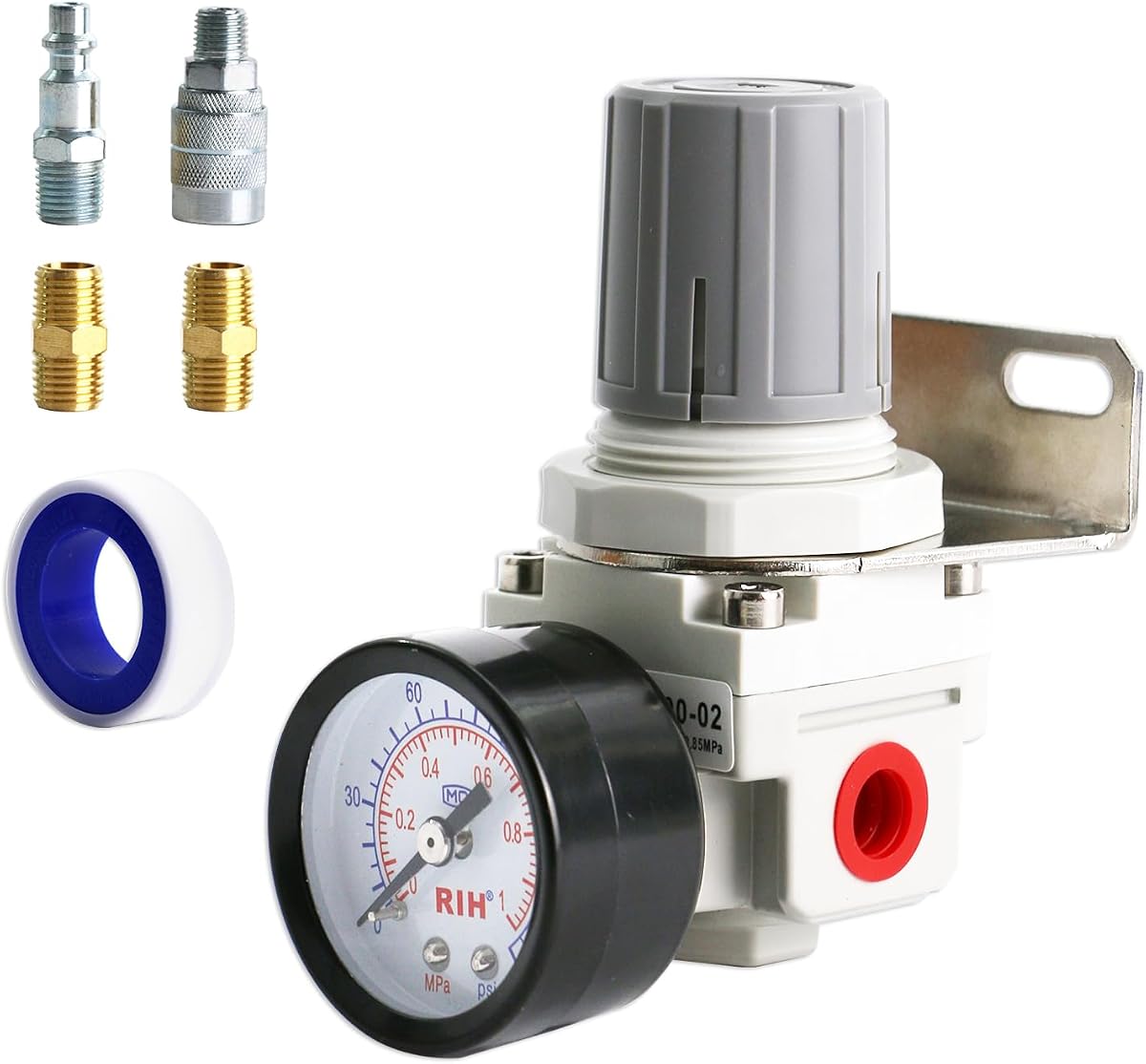
The RIH regulator stands out for its comprehensive kit including couplers and fittings. It holds a very high user rating, indicating satisfaction with its performance and ease of use.
We may earn a commission when you buy through this link, at no additional cost to you.
With an aluminum body and 1/4 inch NPT threads, it is a standard choice for general connections. The full package saves time sourcing extra components.
Its flow rate is modest, so it is not ideal for high-volume tools. However, for typical hobbyist or small workshop use, it is sufficient.
If you want a complete setup straight out of the box, this is a great option. The included accessories make it ready to install immediately without hunting for extra parts.
The inclusion of couplers and tape means you can start using it right away without additional purchases.
Its high rating reflects real-world reliability and user trust in its everyday performance.
We may earn a commission when you buy through this link, at no additional cost to you.
Selecting the right regulator involves considering several technical factors to ensure compatibility and performance for your specific applications.
Ensure the regulator has the correct NPT thread size to match your compressor outlet and air tools. Common sizes include 1/4 inch, 3/8 inch, 1/2 inch, and 3/4 inch, with larger sizes supporting higher flow rates.
Check your existing hose connections before purchasing to avoid needing adapters or fittings.
Flow rate, measured in SCFM or CFM, determines how much air the regulator can deliver without pressure drops. Select a model with a flow rate that meets or exceeds the demand of your tools to maintain performance.
Low flow regulators may struggle when multiple tools are running simultaneously.
Look for a regulator that covers the pressure range required by your tools. Some models support up to 225 PSI, while others max out at 150 PSI, so verify the specifications against your needs.
Ensure the maximum input pressure of the regulator can handle your compressor's output safely.
Regulators are made from materials like aluminum, brass, or composite. Brass and aluminum offer better durability and corrosion resistance, while composites may be lighter but less robust.
Choose a material that suits your environment and expected usage frequency.
Relieving regulators vent excess downstream pressure when adjusted lower, which protects sensitive tools. Non-relieving models simply restrict flow and may retain pressure.
For most shops, a relieving design is safer and more versatile for delicate equipment.
A clear and accurate gauge is crucial for monitoring pressure levels. Look for steel-protected gauges to prevent damage and ensure readability over time.
Consider models that include the gauge as part of the package to save on extra costs.
Some regulators come with wall or panel mounting brackets, while others are inline only. Consider where you plan to install the regulator and if you need a bracket for easy access.
Flexible mounting options make it easier to integrate into tight workspace layouts.
Well-known brands often provide better quality control and customer support. Check if the product includes a manufacturer warranty for added peace of mind.
A warranty can protect your investment against defects and premature failure.
Before installation, ensure all threads are clean and apply Teflon tape to prevent leaks. Screw the regulator onto your compressor outlet or inline fitting securely to avoid air loss.
Adjust the pressure by pulling out the knob if required and turning it clockwise to increase or counterclockwise to decrease. Use the gauge to verify the pressure matches your tool's requirements.
Regularly inspect the gauge for accuracy and clean it if it becomes foggy or dirty. Replace worn O-rings or seals if you notice leaks at the joints.
Leakage is often caused by loose fittings or worn seals. Check that all connections are tight and apply additional Teflon tape if needed. If the regulator is old, the internal O-rings may need replacement.
Most regulators are universal, but you must ensure the thread sizes match. Also, verify that the maximum input pressure of the regulator exceeds your compressor's output capacity for safety.
PSI measures pressure, while SCFM measures airflow volume. Both are important because pressure determines force, and SCFM ensures your tools have enough air to run continuously without stalling.
It is often beneficial to have a secondary regulator at the tool or line. This allows you to fine-tune pressure for specific tools without affecting the main compressor settings.
Calibration depends on usage frequency. If you use it daily in a professional setting, check it monthly. For occasional use, an annual check is usually sufficient to ensure accuracy.
Paint spraying typically requires lower pressures, often between 20 and 40 PSI at the gun. Always check the manufacturer's recommendations for your specific spray gun and paint type for best results.
Whether you prioritize precision, budget, or heavy-duty performance, the models reviewed here offer reliable options for various needs. The PneumaticPlus, Primefit, and Ingersoll Rand models lead in their respective categories.
When making your decision, focus on thread compatibility and flow rate first. These factors directly impact performance and ensure that your air tools function smoothly without interruption.
Remember that prices and availability can shift frequently, so check the latest details before buying. Investing in the right regulator now can save time and costs on tool maintenance later.