
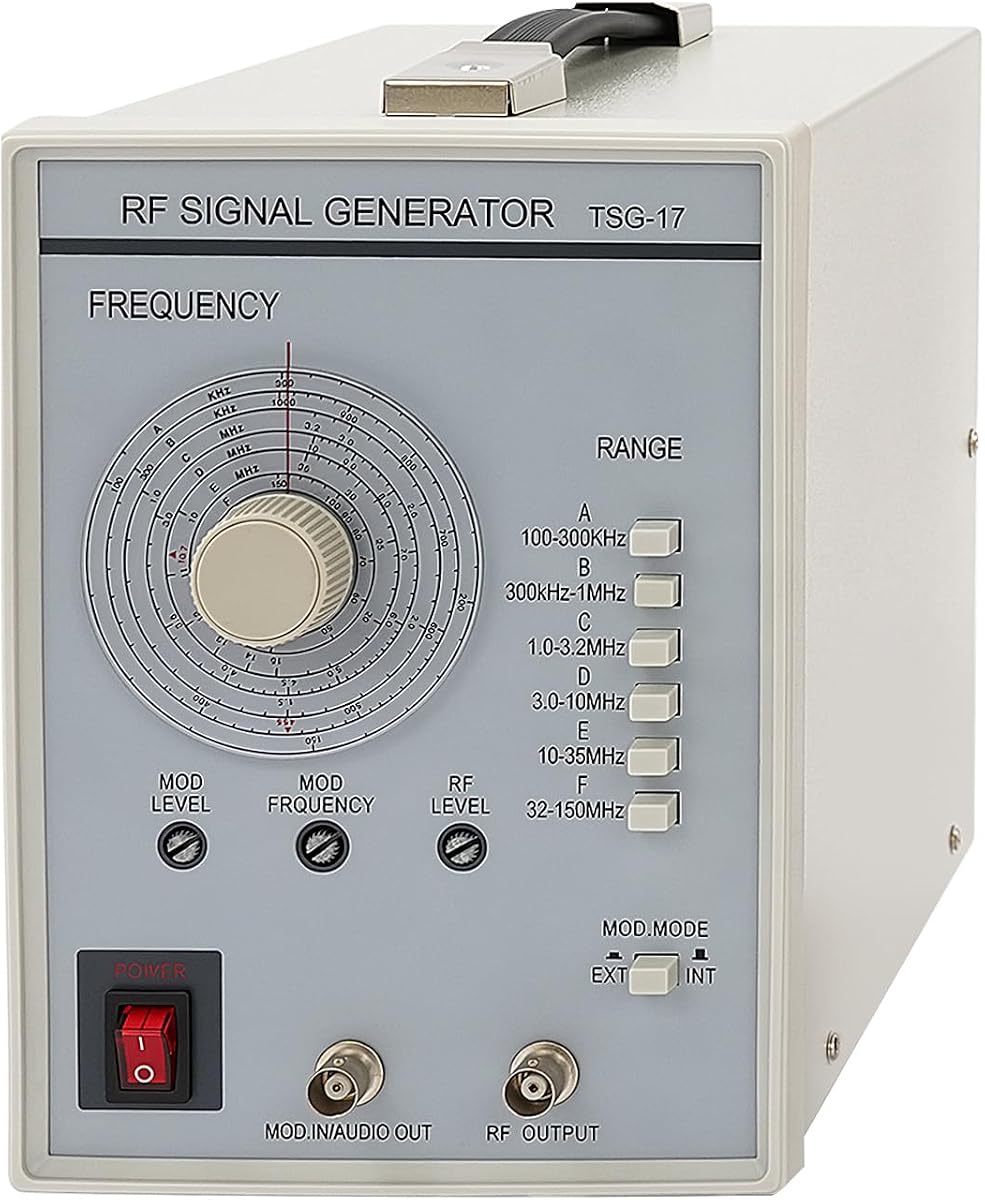
6-Band Signal Generator 100KHz-150MHz
4.2Editor score
100KHz to 150MHz range
Low phase noise design
Affordable pricing
Compare top Amfm Signal Generator models for radio testing and labs. We evaluate frequency range, modulation types, accuracy, and build quality to help you
Amfm Signal Generator devices are essential tools for engineers, technicians, and hobbyists working with radio frequency electronics. They produce precise signals for testing circuits, calibrating equipment, and troubleshooting communication systems efficiently.
We analyzed ten top-rated models available today, focusing on frequency range, modulation capabilities, build quality, and user feedback. Our comparison highlights devices suitable for everything from basic hobbyist projects to advanced laboratory research applications.
Each pick below showcases key strengths, potential limitations, and ideal use cases to help you decide. Remember that product availability and pricing can change frequently, so verify current details before making your final purchase decision.
4.2Editor score

5.0Editor score

5.0Editor score
This side-by-side comparison highlights key specifications across all ten models to help you find the right fit for your specific testing and development needs.




The UNI-T UTG962E stands out as a top performer for those needing a reliable and compact Amfm Signal Generator. With a perfect rating and robust specs, it delivers exceptional value for engineers and enthusiasts alike.
We may earn a commission when you buy through this link, at no additional cost to you.
Its dual channel support allows for simultaneous signal generation, while AM FM and PM modulation options cover a wide array of testing scenarios. The high sample rate ensures precise waveform reproduction for complex tasks.
While the price point is higher than basic options, the build quality and feature set justify the investment for serious users. Some users might find the 60 MHz limit restrictive for ultra high frequency work.
This device is ideal for professionals who need portability without sacrificing performance. It balances advanced functionality with a user-friendly interface making it a strong recommendation for general lab use.
Independent channel control allows testing differential circuits efficiently without needing multiple devices or complex setups.
Support for AM FM PM and FSK modulation makes this generator suitable for diverse radio and communication testing needs.
We may earn a commission when you buy through this link, at no additional cost to you.
The OWON DGE2035 offers a compelling mix of precision and usability for lab environments. Its 14-bit resolution ensures clean signal generation which is crucial for sensitive testing tasks requiring accuracy.
We may earn a commission when you buy through this link, at no additional cost to you.
The color TFT display provides clear real-time feedback allowing users to verify settings quickly without guessing. Additionally, the inclusion of over 150 built-in arbitrary waveforms saves setup time for common test scenarios.
While it lacks the frequency range of higher-end models, it remains effective for many standard electronic and educational applications. Users relying on PC control might face connectivity hurdles depending on their system configuration.
This model is best suited for research labs or educational settings where visualization and standard waveform variety matter most. It offers a reliable alternative for those prioritizing resolution over maximum frequency range.
14-bit resolution minimizes quantization noise ensuring cleaner outputs that are vital for high fidelity signal analysis.
Remote control via USB enables automation and data logging capabilities that streamline complex testing workflows effectively.
We may earn a commission when you buy through this link, at no additional cost to you.
For hobbyists and technicians needing a straightforward tool without breaking the bank, this 6-Band generator delivers solid performance. It covers a wide frequency range suitable for most radio and maintenance tasks.
We may earn a commission when you buy through this link, at no additional cost to you.
Its low phase noise characteristic helps ensure signal purity reducing errors during testing phases. The robust metal construction adds durability making it a dependable choice for field work or workshops.
Lack of advanced features like arbitrary waveform support may limit advanced users needing complex modulation. However, for standard AM FM signal tasks it provides the reliability required at a budget-friendly cost.
This device is perfect for students or repair shops requiring basic signal generation capabilities. It represents excellent value for money when simplicity and durability are prioritized over digital programmability.
Low phase noise ensures high signal purity which is essential for accurate testing of sensitive radio equipment components.
Simple front panel layout and clear markings allow operators to start generating signals quickly without extensive training.
We may earn a commission when you buy through this link, at no additional cost to you.
This generator is unique for its impressive frequency span reaching into the gigahertz range. It serves as a specialized tool for RF work where broader coverage is more critical than complex modulation capabilities.
We may earn a commission when you buy through this link, at no additional cost to you.
Support for sweep mode allows for frequency response testing without requiring external equipment. Its USB power compatibility makes it convenient for field use where standard outlets may not be available.
The limitation to sine wave output restricts its use for more diverse testing scenarios requiring square or arbitrary shapes. Build quality may also not match higher-end units for rigorous daily lab environments.
Ideal for technicians needing a portable RF source across many bands without heavy investment. It balances range and portability well though users should expect basic functionality compared to modern arbitrary generators.
Sweep mode enables automatic frequency scanning which simplifies testing frequency response characteristics of circuits efficiently.
Power options allow operation from mobile chargers making it highly portable for on-site diagnostics and maintenance tasks.
We may earn a commission when you buy through this link, at no additional cost to you.
The TSG-17 is designed for users focusing primarily on AM radio testing and basic frequency applications. It provides fundamental features needed for simple commercial or household maintenance tasks effectively.
We may earn a commission when you buy through this link, at no additional cost to you.
Harmonic output extends testing capabilities beyond fundamental frequencies offering flexibility for specific calibration scenarios. External modulation input adds some versatility for signal injection experiments.
User feedback suggests potential reliability issues which might impact long-term usage confidence. Limited waveform options also mean it cannot replace modern arbitrary generators for complex digital testing needs.
This device might suit niche repair tasks where AM signal injection is the primary goal. Prospective buyers should weigh its limitations against more modern alternatives with better track records.
Harmonic generation allows testing circuits at multiple frequency points without needing to reconfigure the primary signal source.
External modulation input supports signal injection experiments enabling dynamic testing scenarios for radio receivers and filters.
We may earn a commission when you buy through this link, at no additional cost to you.
Though distinct from RF generators this tool is vital for industrial control system calibration. It delivers precise current and voltage outputs needed for PLC and sensor testing applications.
We may earn a commission when you buy through this link, at no additional cost to you.
Built-in battery ensures mobility during field troubleshooting eliminating dependency on wall power. Short circuit protection adds safety for technicians working in complex industrial electrical environments.
It does not generate RF signals so it should not be confused with frequency generators. Users needing high voltage or advanced signal shapes may require supplementary equipment for complete coverage.
This generator is an essential addition for automation technicians focusing on sensor loops. It provides reliable current and voltage simulation crucial for debugging industrial control systems efficiently.
Rechargeable battery allows continuous operation in remote field locations where power outlets are inaccessible or unreliable.
Integrated short circuit protection prevents accidental equipment damage during troubleshooting of complex industrial circuits.
We may earn a commission when you buy through this link, at no additional cost to you.
This generator is optimized for high precision industrial signal simulation tasks. Its dual voltage and current outputs make it versatile for testing various control system components and sensors.
We may earn a commission when you buy through this link, at no additional cost to you.
The four digit display ensures operators can verify settings precisely reducing measurement errors during critical debugging phases. Multiple power modes including USB charging offer flexibility for extended field use.
While it lacks RF capabilities it excels in analog signal calibration scenarios. Its design prioritizes accuracy over complexity making it ideal for technicians focused on precise voltage or current simulation.
Recommended for automation and control system professionals needing a portable high accuracy simulator. It simplifies the testing process with reliable outputs and clear visual feedback.
Four digit display and precision output ensure accurate calibration of sensitive industrial equipment components effectively.
Multiple power input options allow versatile operation in different environments ensuring uninterrupted workflow during testing.
We may earn a commission when you buy through this link, at no additional cost to you.
This device stands out for its advanced visualization and signal variety suited for complex PLC testing. It supports multiple signal types including Hz pulse allowing comprehensive system diagnostics.
We may earn a commission when you buy through this link, at no additional cost to you.
The TFT color screen displays real-time curves helping users visualize changes instantly without external monitors. A large battery capacity ensures long field use without needing frequent recharging interruptions.
It may be overkill for basic tasks but excels in advanced industrial debugging scenarios. The complexity of features requires familiarity with industrial protocols to leverage its full potential.
Best for engineers working on advanced industrial automation needing detailed signal simulation. It combines visual feedback and signal flexibility to enhance diagnostic efficiency and accuracy.
Real-time curve display enables instant visual verification of signal changes speeding up complex diagnostic workflows.
Support for multiple signal types and pulse outputs allows comprehensive testing of various industrial control interfaces.
We may earn a commission when you buy through this link, at no additional cost to you.
A straightforward tool for technicians needing basic analog simulation without complex digital interfaces. Its dual signal support covers most standard voltage and current requirements for simple testing.
We may earn a commission when you buy through this link, at no additional cost to you.
Potentiometer control offers tactile adjustment making it intuitive for quick changes without navigating menus. Its compact design ensures it fits easily in toolkits for on-site maintenance.
Lack of digital display means reading exact values requires external multimeters. This manual approach may slow down work for users needing precise documentation of settings during testing.
This device is ideal for quick field checks and routine calibration tasks. It provides essential functionality in a simple package suitable for general industrial maintenance needs.
Manual potentiometer knobs provide immediate tactile feedback allowing rapid adjustments without digital menu navigation.
Small footprint makes it easy to carry in toolkits for quick field deployment during routine maintenance tasks.
We may earn a commission when you buy through this link, at no additional cost to you.
This generator represents premium performance with dual channel independence perfect for sophisticated circuit testing. Its high sampling rate ensures accurate waveform reproduction even for complex arbitrary signal shapes.
We may earn a commission when you buy through this link, at no additional cost to you.
Phase difference adjustment enables precise synchronization testing critical for differential circuits. The inclusion of sixty preset arbitrary waveforms offers immense versatility without needing custom uploads.
While the price is higher than standard units the features justify the cost for advanced R&D. Complexity may be unnecessary for basic users but essential for demanding engineering laboratory applications.
Ideal for professional R&D labs needing high precision dual channel signal control. It delivers top-tier performance for those prioritizing accuracy and flexibility in complex test setups.
Fully independent channel adjustment enables differential circuit testing with precise phase difference control.
High sampling rate ensures accurate waveform reproduction for complex arbitrary signals in demanding testing scenarios.
We may earn a commission when you buy through this link, at no additional cost to you.
Selecting the right Amfm Signal Generator requires evaluating your specific needs against technical capabilities and usability factors.
Frequency range determines which signal frequencies your device can produce. For RF testing ensure coverage includes your target bands. Higher ranges offer versatility but may cost more.
Choose a range that fully covers your testing requirements without unnecessary excess to maximize value.
Modulation support affects signal versatility. AM FM PM and FSK are standard for communication testing. Ensure the device supports required modulation types for your specific applications.
Look for built-in modulation features to avoid needing external accessories for complex testing.
Resolution impacts signal purity and accuracy. Higher bit resolution reduces noise making it ideal for sensitive circuits. Frequency accuracy ensures consistent output without drift.
Prioritize high resolution and accuracy for precision testing and lab environments.
Portability matters for fieldwork. Consider weight and built-in battery options. USB or mobile power compatibility enhances flexibility during on-site diagnostics.
Select lightweight units with reliable power options for mobile maintenance tasks.
A clear display speeds up setup and verification. TFT screens provide better visibility than monochrome. Intuitive controls reduce training time and operator errors.
Choose user-friendly interfaces with clear visual feedback for efficient operation.
Connectivity options allow PC control and automation. USB interfaces enable remote control and data logging. Ensure compatibility with existing software or test environments.
Consider USB or network connectivity for advanced integration needs.
Durable construction ensures longevity. Metal housings offer better protection than plastic for rugged environments. Check user feedback for reliability insights.
Opt for robust materials to withstand regular field or lab use.
Arbitrary waveform support enables custom signal shapes. Look for built-in presets and memory depth for custom designs. This is essential for complex circuit simulation.
Ensure sufficient memory and custom waveform capabilities if your work requires non-standard signals.
Before use, ensure proper calibration if required. Connect to appropriate load using quality cables to maintain signal integrity. Set frequency and amplitude within safe limits to avoid equipment damage.
Regularly update firmware if supported by the manufacturer. Store in a dry cool environment to prevent internal corrosion. Use protective cases during transport to prevent physical damage to connectors.
Clean connectors with compressed air to remove dust buildup. Periodically verify accuracy using known standards or multimeters. Follow manufacturer guidelines for battery maintenance to ensure long-term reliability.
An Amfm Signal Generator is used to produce precise electrical signals for testing and calibrating radio frequency circuits. It helps verify circuit performance and troubleshoot communication devices efficiently.
Determine the frequencies your target devices operate on. Ensure your generator covers these bands fully. Avoid unnecessarily wide ranges if basic testing is your goal.
Arbitrary waveform generators offer more flexibility for custom signals and complex testing. Standard ones are sufficient for basic modulation needs like AM FM. Choose based on task complexity.
While typical RF generators are for signals, dedicated industrial simulators offer precise voltage and current outputs for sensors. Ensure you select the correct type for industrial PLC testing.
High precision units may need periodic calibration to maintain accuracy. Check if the device has internal calibration features or requires external standards for verification.
USB connectivity enables remote control and data logging for automated testing. It is highly useful in labs but optional for basic handheld maintenance tasks.
Battery life varies by model and usage. High capacity batteries can last several hours on a single charge. Always carry a charger for extended field work.
Most generators output low power but should be used cautiously. Avoid direct connection to unshielded consumer electronics. Always follow safety guidelines for signal injection tasks.
The UNI-T UTG962E, 6-Band generator, and SEESII Dual Channel represent top picks across various needs. Each offers distinct advantages tailored for different testing environments.
Prioritize frequency range and modulation types to match your specific projects. Balance cost with required accuracy and durability for long-term value.
Verify current pricing and availability before purchase. Regularly review product updates to ensure you select the most suitable tool for your evolving technical needs.