
Hosyond 3pcs I2C IIC 1602 LCD Display Module
4.5Editor score
16×2 Character Display
I2C Serial Interface
Adjustable Blue Backlight
This expert guide compares the top 10 Arduino LCD display modules for 2026, evaluating resolution, interface types, and compatibility for your next embedded
Arduino LCD displays are essential components for embedded systems that need to show real-time data or user interfaces. Whether you are building a weather station or a home automation panel, choosing the right screen ensures reliable performance and clear visibility for your project users.
We compared ten top-rated LCD and OLED modules based on resolution, interface type, compatibility with popular boards, and user feedback. Our analysis focuses on how each module integrates with Arduino ecosystems to help you make an informed decision for your specific application needs.
Each pick in this list highlights specific strengths such as cost-effectiveness, touch capability, or superior color quality. Please note that prices and availability may change over time, so verify current listings before purchasing to ensure you get the best value for your build.
4.5Editor score

4.6Editor score

4.7Editor score
The following table provides a side-by-side comparison of all ten featured modules, detailing their key specifications to help you quickly identify which device aligns with your project requirements.




The Hosyond 3pcs I2C IIC 1602 LCD Display Module offers an excellent entry point for hobbyists needing text output. With a 4.5 rating, it is trusted for simple projects requiring clear character display without complex wiring.
We may earn a commission when you buy through this link, at no additional cost to you.
This module uses an I2C interface which reduces pin usage significantly compared to parallel interfaces. The built-in potentiometer allows easy adjustment of the blue backlight to suit different lighting environments.
While it lacks color and advanced graphics, the trade-off is a lower cost and simpler coding requirements. It is ideal for basic status readouts like temperature or sensor values.
You should buy this if you need multiple displays for a budget or are just learning Arduino interfaces. It provides reliable text output for a wide range of standard development boards.
The I2C interface only requires two data lines, freeing up other pins for sensors or controls.
Compatible with standard 5V power supply making it easy to integrate into common circuits.
We may earn a commission when you buy through this link, at no additional cost to you.
The ELEGOO 0.96 Inch OLED Display Screen Module stands out for its self-luminous pixels which provide excellent contrast even in bright light. Its 4.6 rating reflects strong satisfaction among users building dashboards or robot status panels.
We may earn a commission when you buy through this link, at no additional cost to you.
This kit includes three displays allowing you to run multiple projects or keep spares for testing. The fixed yellow and blue zones make status information easy to scan without complex programming.
The main limitation is the fixed color palette which limits aesthetic customization. However, for functional readouts like alerts or graphs this design is highly effective and efficient.
We recommend this for projects needing high visibility and minimal power usage. It works well with common 3.3V and 5V platforms and saves pins with its I2C connection.
OLED pixels light up individually meaning no backlight power is required for dark backgrounds.
The small form factor fits easily into tight enclosures for portable electronics.
We may earn a commission when you buy through this link, at no additional cost to you.
The AITRIP 2PCS 2.0 inch TFT Display OLED LCD delivers premium visual quality with its IPS panel and 240×320 resolution. Users praise its bright output and wide viewing angles making it suitable for handheld electronics.
We may earn a commission when you buy through this link, at no additional cost to you.
Its ST7789V controller supports 262K colors allowing for detailed graphics and menus. The clear pin labels simplify setup reducing the risk of wiring errors during prototyping.
While it uses SPI interface which requires more pins than I2C the visual payoff is significant. This is ideal for projects needing rich media or interactive UI elements.
Buy this if you need a high-quality display for dashboards or handheld devices. The included two units offer good value for building prototypes or backup modules.
In Plane Switching technology ensures colors remain consistent even at wide viewing angles.
262K colors allow for realistic images and detailed status indicators.
We may earn a commission when you buy through this link, at no additional cost to you.
The ELEGOO 2.8-Inch TFT Touch Screen is designed for interactive projects where user input is required. It features a 320×240 display and supports resistive touch input with a stylus for menu navigation.
We may earn a commission when you buy through this link, at no additional cost to you.
An onboard SD card slot allows storing project assets directly on the display module. This is useful for devices needing to load images or logs without external storage.
The shield format connects through UNO headers making it compatible with standard Arduino boards. However parallel interface usage requires significant pin resources compared to serial options.
Choose this for robotics or custom control panels where touch interaction is needed. It provides a solid foundation for complex interfaces despite higher pin requirements.
Resistive touch allows for simple button and menu interactions without complex drivers.
The SD slot enables direct storage of project data and assets.
We may earn a commission when you buy through this link, at no additional cost to you.
The GeeekPi 2-Pack I2C 1602 LCD Display Module is a solid choice for IoT projects needing character output. It uses the I2C protocol to minimize wiring while maintaining reliable display performance.
We may earn a commission when you buy through this link, at no additional cost to you.
The built-in potentiometer allows precise control over backlight and contrast which helps in varying lighting conditions. Two units are included making it easy to deploy multiple readouts.
While it offers no color capabilities its simplicity ensures stable performance for basic data readouts. It is widely compatible with various boards including Raspberry Pi and STM32.
Buy this for home automation or smart building projects. It is efficient and easy to integrate into existing circuits with minimal hassle.
I2C reduces wiring clutter significantly which is crucial for neat projects.
Works with many development boards making it versatile for different ecosystems.
We may earn a commission when you buy through this link, at no additional cost to you.
The Freenove I2C IIC LCD 1602 Display Serial integrates the conversion circuit directly on the board for improved stability. It is designed for mainstream models like Arduino and ESP32 with example projects included.
We may earn a commission when you buy through this link, at no additional cost to you.
A tutorial link provided on the box offers guidance for setup without paper manuals. Technical support is available for questions which helps beginners get started quickly.
This module focuses on reliable text output with minimal configuration. It is ideal for learners who want to focus on coding rather than complex hardware setup.
Choose this for school electronics or maker projects requiring stable text display. The included examples save time and reduce errors during initial setup.
The new model integrates conversion circuits to ensure more stable serial communication.
Code examples and tutorials are provided to ease the learning curve.
We may earn a commission when you buy through this link, at no additional cost to you.
The SunFounder IIC/I2C/TWI LCD1602 Display Module is designed for ease of use with direct library support. It reduces port occupation significantly with just four wires needed for connection.
We may earn a commission when you buy through this link, at no additional cost to you.
A built-in potentiometer allows for quick adjustment of backlight and contrast without external components. The clear documentation ensures smooth integration with Arduino and Raspberry Pi.
This module excels in simplicity providing a straightforward solution for character displays. It is reliable for basic readouts and status indicators in many embedded systems.
Buy this for projects where setup speed and simplicity are priorities. It provides a solid foundation for text-based interfaces with minimal friction.
Compatible I2C LCD1602 library allows for direct calls without complex code.
Only four wires are needed which keeps the breadboard clean and organized.
We may earn a commission when you buy through this link, at no additional cost to you.
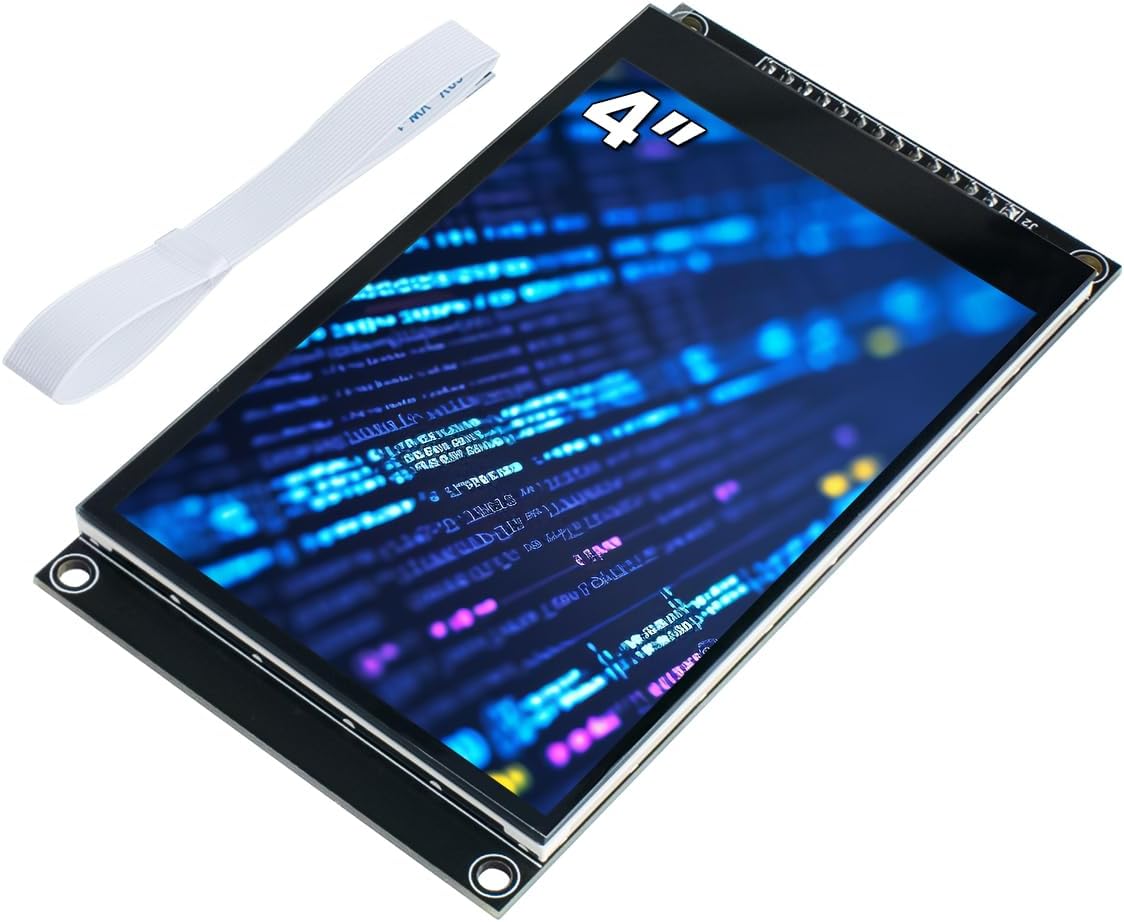
The Hosyond 4.0 Inch 320×480 TN Capacitive Touch Screen LCD Display Module offers a larger interface for complex projects. Its capacitive touch panel provides more accurate input than resistive screens.
We may earn a commission when you buy through this link, at no additional cost to you.
The ST7796S driver supports 65K colors and a TF card slot for storage expansion. This makes it suitable for devices needing to show rich graphics or store media.
Setup requires SPI interface which uses more pins than I2C and demands careful logic level matching. However the larger screen real estate makes it valuable for dashboards.
Choose this for handheld electronics or IoT devices needing touch input. It balances size and functionality for advanced visual output needs.
Newly upgraded capacitive panel offers smoother interaction than resistive screens.
A micro TF card slot allows storing assets directly on the module.
We may earn a commission when you buy through this link, at no additional cost to you.
The Hosyond 5 Pcs 0.96 Inch OLED I2C IIC Display Module provides a bulk set of self-luminous screens. With 128×64 pixels and a 4.6 rating it is ideal for multiple project needs.
We may earn a commission when you buy through this link, at no additional cost to you.
These modules require no backlight and offer ultra-high contrast for bright clear dots. Users can create custom fonts though no fonts are embedded in the controller.
The blue and yellow color options allow for basic visual distinction between units. It consumes low power which is beneficial for battery operated projects.
Buy this for building multiple sensor dashboards or classroom demos. The five units provide excellent value for scaling up your display capabilities.
Self-luminous pixels use very little power which is great for battery life.
Fonts are not embedded so users can generate custom styles easily.
We may earn a commission when you buy through this link, at no additional cost to you.
The 2inch LCD Module Mini LCD Screen offers a compact IPS panel with 240×320 resolution. It supports 262K colors making it suitable for detailed graphics in small form factors.
We may earn a commission when you buy through this link, at no additional cost to you.
Its SPI interface requires minimum GPIO pins which helps preserve resources for other sensors. Ensure the power supply and logic voltages are consistent to avoid operational issues.
While not as colorful as larger displays its size and resolution make it a strong contender for handheld devices. It balances visual quality with compact dimensions effectively.
Buy this for handheld electronics where space is tight. It provides reliable visual output for compact projects needing color.
SPI interface reduces the number of pins required for control.
262K colors allow for vibrant and accurate image reproduction.
We may earn a commission when you buy through this link, at no additional cost to you.
Selecting the right display depends on your project needs interface preferences and budget. Consider these factors before buying to ensure compatibility and performance.
LCD displays use liquid crystals with backlighting while OLEDs emit their own light. LCDs are generally cheaper and good for text while OLEDs offer higher contrast and lower power.
Choose LCD for basic text projects and OLED for better visibility and battery life.
Resolution determines how much data you can show clearly. 16×2 modules only show text while 240×320 or higher supports graphics and maps.
Higher resolution allows more complex interfaces but requires more processing power.
Interfaces like I2C use fewer pins than SPI or parallel. I2C is simpler for basic setups while SPI allows faster updates for graphics.
Choose I2C for simplicity and SPI for high-speed color graphics.
Some modules require 5V while others work at 3.3V. Ensure your board matches the module to avoid damage or instability.
Verify logic levels before connecting to ensure safe operation.
Resistive screens need pressure while capacitive screens respond to light touch. Capacitive is better for menus but resistive works with gloves.
Consider if touch is needed and which type fits your usage.
Measure your enclosure to ensure the display fits comfortably. Larger screens need more space and may require stronger mounts.
Select a size that fits your project case physically.
Popular drivers like SSD1306 and ST7789V have extensive libraries. Less common drivers may lack documentation or community support.
Choose modules with well-documented drivers for easier coding.
OLEDs consume less power when showing dark screens while LCDs always use backlight power. This impacts battery life in portable devices.
Check power specs if you are running on battery.
Connect the display pins to your board according to the data sheet. Use jumper wires carefully and ensure voltage levels match to prevent short circuits.
Install the appropriate library for your display driver in your IDE. Use example code to verify the connection before implementing your own logic.
Clean the screen with a dry microfiber cloth to avoid scratches. Avoid touching the screen with sharp objects and keep it away from moisture.
I2C is usually best for saving pins while SPI is better for fast graphics. Parallel interfaces are rarely used now due to high pin count.
Yes you can use multiple displays if they have unique addresses or use a multiplexer. Make sure to change the I2C address code correctly.
Static elements can cause image retention on OLED screens over long periods. It is best to rotate content or dim the screen periodically.
Common libraries include LiquidCrystal I2C for LCDs and Adafruit SSD1306 for OLEDs. Always check the manufacturer page for the latest compatible versions.
Most modern modules support both 3.3V and 5V. Always verify the voltage range on the module labels before powering up.
Check wiring connections and ensure the contrast potentiometer is turned up. Verify the I2C address matches your library configuration.
We recommend the ELEGOO OLED kit for its balance of quality and value for general use. For premium color needs the AITRIP TFT offers superior resolution and display quality.
Prioritize interface type and voltage compatibility to ensure your build runs smoothly from the start. Matching the module to your project goals saves time and frustration.
Remember to check current prices and stock availability since these change frequently. With careful selection you can build a reliable and visually appealing project.